How to Form an Open Voicing Chord by: Ido Ronen from www.piano-play-it.com
Hi Cheri,
I am familiar with the difficulty of recognizing what is the exact chord when it is played in open voicing.
It requires a lot of experience before you can immediately recognize the chord.
Here is a list of 4 steps, one by one, that will help you to understand which chord is being played:
1. What is the bass note of the chord? Remember this - you will need it later on.
2. If a note occurs twice in the chord, you should eliminate one of them. How many different notes did you get? If you got 3 notes, it means that you have a triad.(major chord, minor chord etc.) If you got 4 notes, it means that you have a seventh chord.
3. If the bass of the chord is different from the name of the chords, you have a slash chord. Otherwise, the chord is the one from step 2.
Here is an example which will make things clearer:
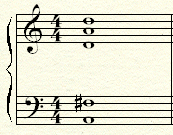
Which chord is written below?
Here are the steps that are mentioned above:
1. The bass is A.
2. Which notes are there? From the bottom: A-F#-D-A-D. We have three different notes: A F# and D. Q: What is this chord? A: D major. (If you are not sure why is this a D major chord go to our chord course.).
3. The chord is D, but the bass is different. It means that you have a slash chord- D/A
This procedure can take several minutes at first, but after repeat this hundreds of times it takes less than one second.