Sus Chords on the Piano
Home » Piano Chords » Sus Chords
Suspension chords are chord which are put before dominant chords most often in order suspense the clear tension of
the dominant resolving to the tonic.
What we have here is actually a clear case of a subdominant.
The first suspension chord we're going to discuss is the sus7 chord.
Sus7 chords appear often before the dominant seven as I've just mentioned.
Let's look at Gsus7 for example.
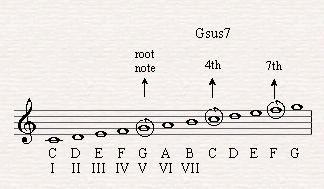 This chord contains
three notes, the root note of the fifth degree (G) the fourth note of the chord (C) and the seventh note (F).
This chord contains
three notes, the root note of the fifth degree (G) the fourth note of the chord (C) and the seventh note (F).
This chord is almost similar to G7 accept is has the fourth note (C) instead of the third note (B).
Although sus chords look almost like dominant chords their duty in music is to suspense the tension before leading to the dominant. They function as a subdominant really.
Sus chords do not have the identity of a major chord or a minor chord since they don't have the third in the chord (Because the fourth note is being solved to the third note of the next chord). They basically have three notes; the root note, the fourth note and the seventh note.
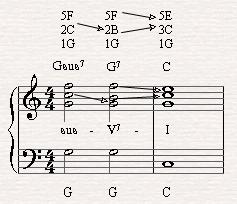 Here's an example
of Gsus suspending the tension before going to G7, the dominant (V7) of C.
Here's an example
of Gsus suspending the tension before going to G7, the dominant (V7) of C.
The fourth note C will is functioning as suspension by creating a dissonance and is about to resolve by step in the
following chord (G7) to the third note of the chord (B).
That's the true meaning of the suspension chords.
Now you may wonder what the function of the seventh in the chord is.
Well the seventh note (F) in our case is being held to the next chord G7 and resolves in the tonic to the last chord to a point of a final rest.
Sus4 Chords
Let's see another case of a sus chord with a bit less tension; the sus4 chord.
The sus4 chord functionality is the same only it doesn't have the seventh note but the fifth instead which is more neutral then
the seventh.
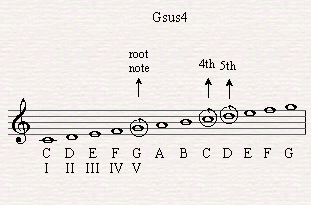 This chord has
three notes as well; the root note G, The fourth note (C) and the fifth (D). Since this chord does not have the seventh note
it will resolve to a Plain G chord instead resolving to a G7, the dominant seventh chord.
This chord has
three notes as well; the root note G, The fourth note (C) and the fifth (D). Since this chord does not have the seventh note
it will resolve to a Plain G chord instead resolving to a G7, the dominant seventh chord.
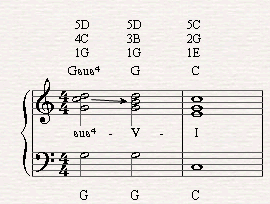 The fourth
note in this case is resolving to the third note just like the previous example we saw of Gsus7 but D, the fifth note stays in
its place and moving to C as we proceed to the tonic.
The fourth
note in this case is resolving to the third note just like the previous example we saw of Gsus7 but D, the fifth note stays in
its place and moving to C as we proceed to the tonic.
Sus2 Chords
The last case of sus chord we're going to discuss in this page is the case of sus2 chords. This chord has the same functionality as well only instead of using the fourth note to create the tension toward the third note from above we're using the second note of the chord to create tension from below.
Let's take Gsus2 for example.
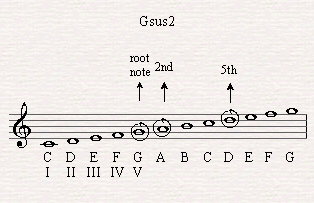 This chord has three
notes as well; G the root note, A the second note and D the fifth note.
This chord has three
notes as well; G the root note, A the second note and D the fifth note.
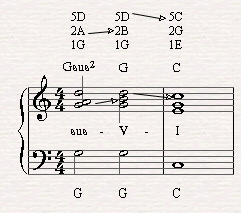 The First
note and the fifth will remain with us in the next chord G. The second note is unstable and will resolve to B, the third note in G.
Finally G the dominant of C is going to resolve to the tonic.
The First
note and the fifth will remain with us in the next chord G. The second note is unstable and will resolve to B, the third note in G.
Finally G the dominant of C is going to resolve to the tonic.
 People want to learn how to play chords in order to be able to play any song they desire easily.
Some find it easy to learn how to form new chords but don't know how to take the next step to
combine them in a song, moving smoothly from one chord to the other while playing the rhythm at the same time
People want to learn how to play chords in order to be able to play any song they desire easily.
Some find it easy to learn how to form new chords but don't know how to take the next step to
combine them in a song, moving smoothly from one chord to the other while playing the rhythm at the same time
Some like to imitate what they see on a video but you can learn how to form all possible amazing piano chords and learn to play an enormous amount of different styles like Pop, Rock, Blues, Jazz and more while playing popular songs by artists like the Beatles, Adele, Bruno Mars, Leonard Cohen and more.
Check out our complete "Piano by chords" course where you'll go through a journey that combines both piano lessons and piano tutorials that will make you play the piano like a PRO!
Click here to check out the Piano by Chords Learning Kit Now!