Three Christmas carols, free
Jingle Bells, Silent Night and We Wish You a Merry Christmas, written in finger numbers instead of notes, with a page that explains how to read them. Leave your name and I will send it over, and write a few times a year when there is something worth your time.
The 12 Bar Blues
Home » Piano Chords » 12 Bar Blues
In order to learn about the 12 bar blues we first have to discuss the development of the blues.
The blues was first being sung by the slaves who where brought to America from Africa. It was their way to express sadness, distress and pain. The meaning of "blue" is not completely defined but it has to do with a melancholic or sad feeling. The blues and the blues scale have these characteristics of sadness in their nature, caused by bending some of the notes in the scale. The so called Blue Notes.
12 Bar Blues Piano Lesson by pianoplayit
Yet, the blues could be played in a cheerful vibe as well, and especially with some interesting rhytmic figures which were brought by the African culture.
The form of the blues was not solid at first. The slaves just sang their heart out without any boundaries. The text of the blues was not always so clear. You basically sang what you felt at the moment. It wasn't composed but improvised mostly.
Later on the form of the blues became more clear and was treated as a standard scheme of 12 bars and the text and musical structure was being set.
The first four bars included the first musical line and text introducing the blues theme. The second four bars repeated this line to increase the impact and the closing line (which is being played in the last four bars) included a conclusion of the first and second line.
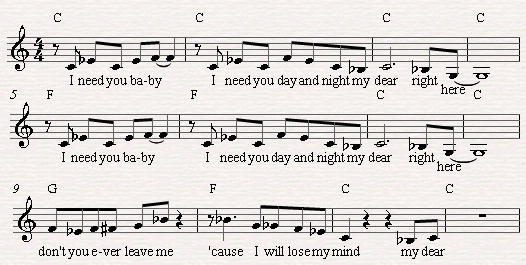
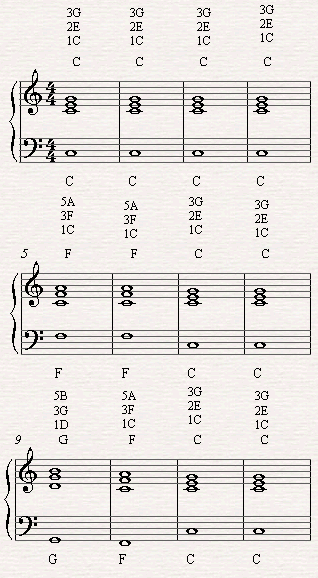
The standard harmony of a simple major blues is built of the first, fourth and fifth scale degrees of the major scale:
I suggest you study the form of the blues by heart. You're going to use it many time to when we'll learn to improvise. It is so easy to learn it and a great place to start your improvisation lessons with.
The blues scale was being sung later over this chord scheme, which you're soon going to find, is quite different then the major or minor scales. It's not diatonic, more than that it contains all the "wrong" notes.
The notes in the blues work differently then in the major and minor scales. Instead of being solid or having a clear and strong function within the scale,
they supply a certain impression or a mood, the blue mood.
That's why the notes in the scale are called blue notes.
We'll discuss the blues scale in details once we're through with this page (Or Click here if you can't wait).
For now I'd like to show you the 12 bar blues in the minor form.
The Minor Blues
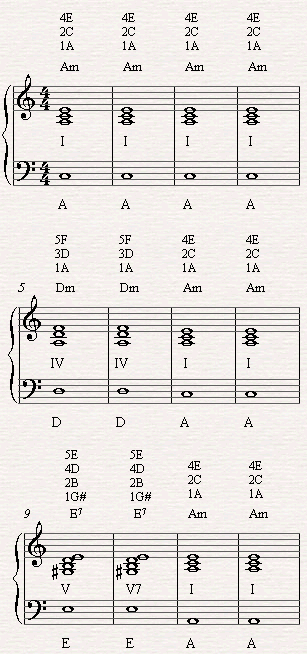
The blues can be sung also in a minor atmosphere.
Instead of playing the first fourth and fifth degree of the major scale we'll play the first, fourth and fifth degree of the minor scale.
The scale we're going to use to improvise over this chord scheme is the minor blues scale which we will discuss in our next chapter where we're going to learn about the blues scale. Click here to learn about the Blues Scale
Or Click here to go to the blues chords page to learn how to add color to the plain chords of the 12 bar blues scheme.
Last bu not least, there's a way to play with the chords of the 12 bar blues scheme and replace to create more interest in the scheme. We're going to talk about it in the Blues Chord Progressions Page.


