Music Terms for Beginners
Home » Piano Notes» Music Terms for Beginners
You'll find some of the most common and important music terms that has to do with piano playing in this page.
Repeat Signs
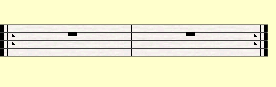
The double dots inside the double bars indicate that everything between the double bars must be REPEATED.
If you only see the closing dotted bar and no opening dotted bar it means you have to repeat the whole piece staight from the top and all the way back to the dotted bar.
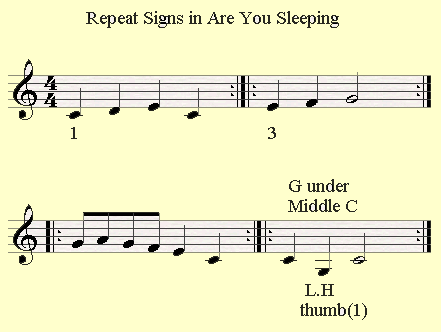
Play this piece next and follow the repeat signs.
In the Hall of the Mountain King by Grieg Download
Pick Up Bar / Up Beat Bar
Some pieces start with an INCOMPLETE MEASURE.
We call it a pick up bar.
The first measure in this piece has only 3 counts.
The missing beat is found at the last measure.
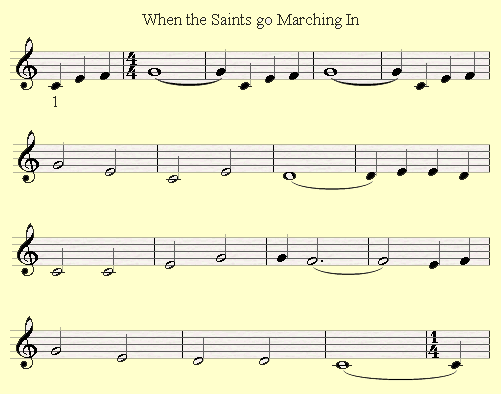
When you repeat the whole piece, you will have one whole measure of 4 beats as you play the last measure of last bar combined with the first incomplete measure.
When a piece begins on a weak beat - like the second bar in our case, you must therefore ACCENT the first beat after the bar line in order to help the listener understand where he's at.
Let's practice some pieces with a pick-up bar.
Oh Susanna Download
William Tell Download
8va
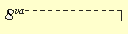
When the 8va sign is placed over the notes, you should play the note
1 octave (8 notes) higher than written.
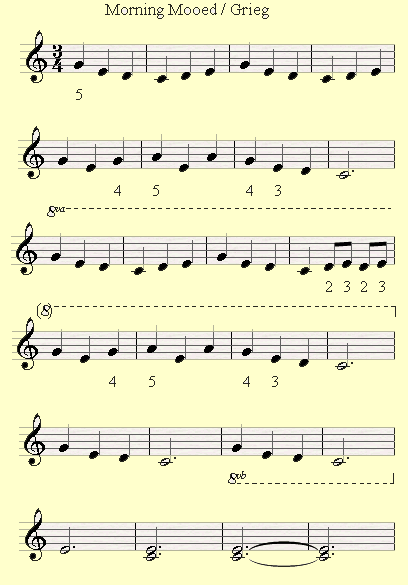
This sign is often used to write the higher notes in a more comfortable way. Instead of sweating while trying to locate the notes above the staff with many ledger lines we simply write the notes an octave lower, on the staff, and we add the 8va sign above.
We might use the 8va to write very low notes under the staff in a more comfortable way as well, but then we'll place the sign under the staff.
First Ending / Second Ending

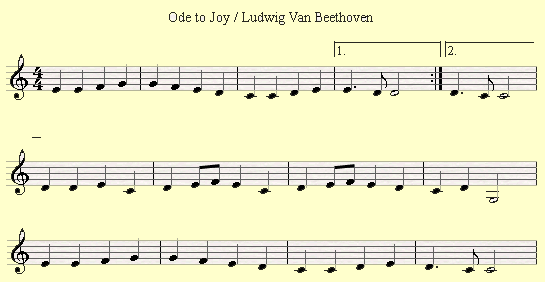
This music term tells you to go to different endings after repeating a part of a piece.
During the first time you have to follow the sign of the first ending, and after repeating the piece between the dotted bars you have to skip the first ending and go straight to the second ending.
Da Capo Al Fine
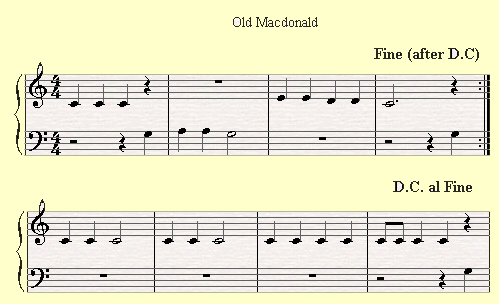
This music term means that you have to back to the beginning and play the whole piece through until you read the Fine sign which means The End.
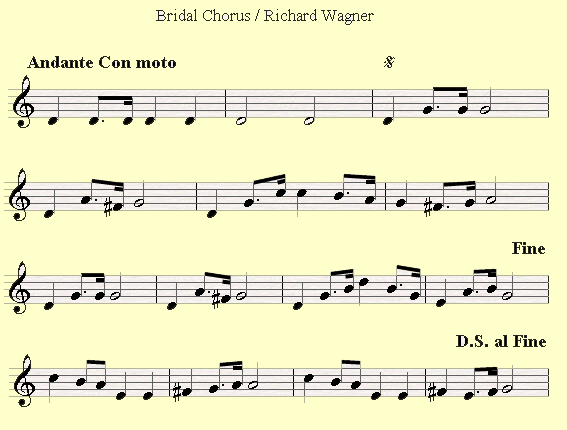
Da Segno al Fine

When you see the De Segno al Fine Sign you should go back to the S sign instead of going to the beginning like the D.C al Fine Sign and play through until the FINE.

If you want to learn more about reading piano notes you should definately check out the Rocket Piano Ultimate Learning kit. Rocket Piano provide an amazingly handy and effecive piano course on various issues such as reading piano notes, playing piano by chords, piano technique and more.
You're going to love the way they work systemically with the help of their useful audio
and video files that are short and to the point. By working
with Rocket Piano you basically guarantee that you'll become pro at reading piano notes
(And the big bonus is you'll learn to play piano by ear as well).
Check out the Ultimate Piano Learning Kit of Rocket Piano Now!