Three Christmas carols, free
Jingle Bells, Silent Night and We Wish You a Merry Christmas, written in finger numbers instead of notes, with a page that explains how to read them. Leave your name and I will send it over, and write a few times a year when there is something worth your time.
Piano Chord Chart
Home » Piano Chords » Piano Chord Chart
In order to help you learning to play the piano chords of the major and minor chords correctly I added this useful chord chart to the beginning piano lessons.
The sheet music here is free. There is no username, no password and nothing to sign up for. If you would like to know when new tutorials and sheets go up, join Piano Playground, our free newsletter. It is one email now and then, and nothing on this site depends on it. |
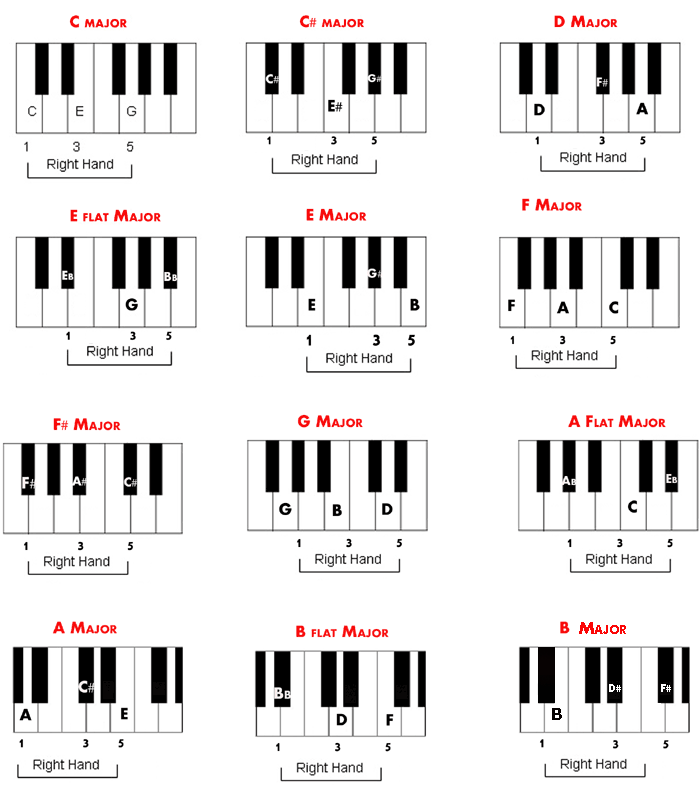
Click here to download a printable version of the Major Chord Chart.
Here's a useful exercise...What I suggest is that you choose a key on the piano (Gradually you'd like to find the major chord of every chosen key) and look for its major chord. Trust your ear. Don't be too logical about music since it won't get you to having a musical intuition on the long run.
If you think you got the major chord correctly check it here in the piano chord chart to see if you're right!
Good luck!

Before we continue I'd look you to pay attention to something in this piano chord chart. Look at C# major. You may be wondering why its middle note is stated as E# and not F. Well, this is important to the understanding of how chords are built.
Chords derive from a scale. For example C major derives from C major scale. We form the chords by playing the first, third and fifth note of the scale. In C major scale for example we press on C we skip the D press the E etc....
So we always measure chords in intervals of thirds. (C-E-G) (D-F#-A) (E-G#-B). In C# major for example the root note is C#, therefore its third note must be E# and not F. The distance between C# and F is of a four notes (C D E F) instead of three (C D E). That's how we know if a certain interval is diminished or augmented.


