Slash Chords
What's a Slash chord?
When we accompany a song we play the harmony (the chords) with the right in the middle register of the piano and the bass note of the chord with the left hand.
The bass note is the most important of the chord. So if a C major is made out of the notes C-E-G we'll mostly play the note C with the left hand. However when we would like to play a C major chord in the first inversion then E turns to be the lowest note of the chord (Because you invert the chord from C-E-G to E-G-C).
So how are we going to write a chord that needs to be played in a certain chord inversion?
This chord will then be written as a slash chord. Since the bass is the most important note of a chord you can say that a chord is identified by the bass note.
When you play a different bass note you change the color and the identity of the chord.
| A slash piano chord tells us that we need to play a different bass in the left hand. The letter by the addition of the slash tell us which CHORD we have to play in the right hand and the letter after the slash tells us which BASS NOTE we'll play with the left hand |
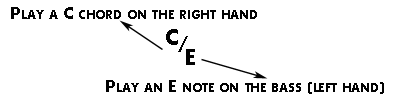
Take this slash piano chord for example. The upper letter tells us we have to play a C chord in our right hand. The lower letter tells us we have to play an E note instead of a C note in the bass.
But why do we need the slash piano chords?
Well, we use it for two reasons.
1.Chord Inversions: Take C/E for example. This chord tells us we are expected to use the C chord in its first inversion. When we play C/E with E in the bass we basically play a C chord in an open position of the first inversion.
2.Extensions: When the bass note of a slash chord is not included in the notes of the chord in the right hand you can assume that this chord is an upper structure chord.
Later when we discuss some jazzy chords we'll learn about extensions which are extra notes you can add to a chord in order to spice up its sound. Sometimes you can use a slash chord instead writing all the extensions of the chord. Bottom line, a slash chord is sometimes just a simple way of describing complicated chords in a simple manner.
D/E is a good example for it. Try to play a D chord on the right hand and an E note on the bass and you'll here a magical chord that has a completely new sound. Now I could talk on and on about the relationship between the bass and right hand but it's so simple to write the chord as a slash chord ans save all the unnecessary explanations.
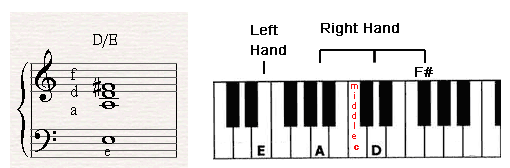
Two Examples that contain a song with slash chords.
Imagine / John Lennon
The song Imagine by John Lennon which we are about to play in the next lesson goes as follows:
| C | F | C | F | F/C | x2
| F C/E | Dm | G | G |
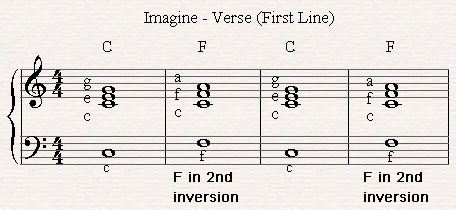 The first line has two chords and I'll show you how to play it in the next piano lesson. We'll move from C major in the root position to F in the 2nd position because it's the closest inversion
the C major in the root position.
The first line has two chords and I'll show you how to play it in the next piano lesson. We'll move from C major in the root position to F in the 2nd position because it's the closest inversion
the C major in the root position.
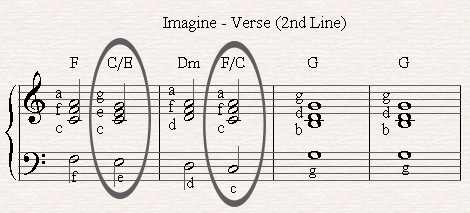
The first bar of the second line contains two chords. We have to move from the F note to the C/E chord after two counts so we have to be quick.
Our hand is already positioned on the second inversion of F. The chord C/E tell us we have to play a C chord in our right hand and an E chord in the left hand.
Moving to C in the right hand is easy. We simply place our fingers back on C major in the root position.
In the left hand we will move from the F note in the lower register of the piano
to E instead of C and by doing that we will create a musical line that will take us to
Dm with a logical bass line (which is moving from F to D stepwise.
We'll continue to move with the left hand to C in the bass in steps and we'll switch from Dm in its root position to an F chord in its second inversion to finish this smooth melodic line at the bass.
All together we haven't moved much on the piano and we performed a pleasant musical line at the bass thanks to the handy slash chords.
Hello / Lionel Richie
The beginning of the verse of the song Hello by Lionel Richie provides us with a good example for how a complicated chord could be written easily with a slash chord.
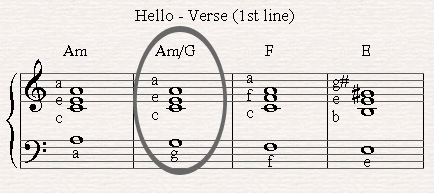
We'll start from Am in the 1st inversion. When going to the next slash chord all we have to do is change the bass note in the left hand from A to G.
What happened? Not much!
We are actually still playing an Am chord but we perform a clear musical line in the bass which moves stepwise just like the song Imagine.
Going to F is the next natural step.
We move from G in the left hand to F and we play an F chord with the right hand.
The purpose of the slash chord in this line is to play an inversion of a seven chord called Am7 in the 3rd inversion. We will discuss the seventh chords later in our piano chord lessons but here's a simple way to write such a chord without having to explain so much.
So now that you know how to read slash chords we can play a song that contains one. Before we'll go to the next piano tutorial I want us to learn another major chord - the E Major chord.
 People want to learn how to play chords in order to be able to play any song they desire easily.
Some find it easy to learn how to form new chords but don't know how to take the next step to
combine them in a song, moving smoothly from one chord to the other while playing the rhythm at the same time
People want to learn how to play chords in order to be able to play any song they desire easily.
Some find it easy to learn how to form new chords but don't know how to take the next step to
combine them in a song, moving smoothly from one chord to the other while playing the rhythm at the same time
Some like to imitate what they see on a video but you can learn how to form all possible amazing piano chords and learn to play an enormous amount of different styles like Pop, Rock, Blues, Jazz and more while playing popular songs by artists like the Beatles, Adele, Bruno Mars, Leonard Cohen and more.
Check out our complete "Piano by chords" course where you'll go through a journey that combines both piano lessons and piano tutorials that will make you play the piano like a PRO!
Click here to check out the Piano by Chords Learning Kit Now!