Three Christmas carols, free
Jingle Bells, Silent Night and We Wish You a Merry Christmas, written in finger numbers instead of notes, with a page that explains how to read them. Leave your name and I will send it over, and write a few times a year when there is something worth your time.
Piano Chord Theory
Home » Piano Chords » Piano Chord Theory
In the next chord piano lesson I'll show you everything you should know about the theory behind piano chords. Learning to play the piano becomes easier when you understand how music is structered.
As far as I'm concerned this is a step further in world of piano harmony. It's not so complicated to follow and anyways, I believe we all should be eager to know more and get to the bottom of music in order to become better musicians.
However, it's also possible to play chords just by reading the symbols and following the songs. Al-right, let's get to business with the basics of piano chord theory.
When we use chords in a song we do it in order to accompany a certain melody.
But where do the chords derive from?
Well, just like the melody of song derives from a certain scale (For example the melody of "Jingle Bells" is based on a major scale) so does the chords.
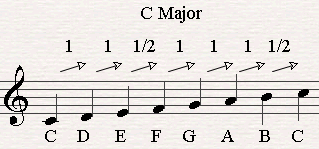
Let's say we play Jingle Bells in C major. We could assume that the melody will be written out of the notes of C major.
And it really is so:

This is very useful for playing melodies by ear since it helps us to know the logic in a song and limit our notes options. All we have to do is hear if a song derive from a major scale or a minor one, and then trust our ear and intuition to figure the melody out.
But what happens if we would like to find the harmony of a song? Is there some logic in that aspect too? You bet there is! Just like melodies, chords derive from scales. That's the basics of piano chord theory. So if we would like to find the harmony of "Jingle Bells" we would search for chords that belong to C major.
 Let's get to know the family of C major. This is quite easy. The members of the family are very friendly.
Scales are divided to scale degrees. We state their number in roman letters.
Let's get to know the family of C major. This is quite easy. The members of the family are very friendly.
Scales are divided to scale degrees. We state their number in roman letters.

The first chord of C major scale would be C major. We start from C, and then we skip a note in the scale. Then we press on E, then skip a note again and press on G. This is already familiar to you - I'm sure.

The second chord of C major would be D minor. We start from D skip the E, Press on F (we follow the notes of the scale), skip G , and press on A.
We continue this procedure and this is what we get.

Piano Chord Theory Exercise
Find all the chords of C major from the first degree to the seventh degree. Play the chord with the right hand and the bass with the left hand. After you found a chord name its degree and its type (minor, major or diminished).
O.k. now we are familiar with the family of C major. Are the other major chords any different?
Not at all. Since all major scales share the same sequence of tones and half tones then all the chords of a major scale would appear in the same order according to their scale degree. D minor for example, is the second chord on C major. We can say that the chord which is built on the second scale degree of G major (A) would be a minor chord a well (Am).
This next image explains my words clearly.

Later on when we are a bit further with piano chord theory we will learn to transpose songs into different scales. This information of piano chord theory would be very valuable to us then but let's take it one step at the time.
Another Piano Chord Theory Exercise
Find all the chords of these major scales from the first degree to the seventh degree. Play the chord with the right hand and the bass with the left hand. After you found a chord, name its degree and its type (minor, major or diminished). G, D, A, E, B
If you're motivated you could find the chords of all scales. This takes quite some time and isn't always useful for it's a lot of information to process.
Chords in the Minor Scales
The chords in the minor scales are formed at the same way as in the major scale. Since every major scale has its parallel minor scale you can say that the chords of A minor for example are parallel to the chords of C major only starting from the sixth degree.
The only chord which stands as an exception to this rule is the fifth degree. We're going to cover that in our next lesson where we're going to talk about the three triads of the main scale degrees so stay tuned.

The sheet music here is free. There is no username, no password and nothing to sign up for. If you would like to know when new tutorials and sheets go up, join Piano Playground, our free newsletter. It is one email now and then, and nothing on this site depends on it.
Click here for a full printable piano chord chart of both major and minor chord scales degrees.


